Noodles: A Strategic Choice for Friendly, Flexible Display Typography
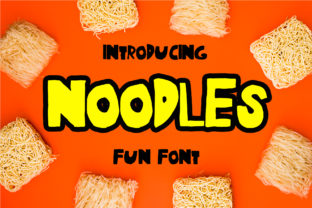
When you choose a display font, you’re not just selecting letters—you’re making a decision about tone, audience alignment, and visual hierarchy. Noodles stands out not because it’s trendy, but because it’s intentionally approachable: round, open, gently irregular, and full of quiet confidence. It’s a display font built for clarity without stiffness, warmth without whimsy, and versatility without compromise. For professionals who need typography to support—not distract from—their message, Noodles offers a rare balance: it invites attention while remaining legible, distinctive while staying readable at scale.
Why Noodles Fits Real-World Goals—Not Just Aesthetic Preferences
Strategic typography starts with intention—not inspiration. If your goal is to humanize a brand voice, soften technical messaging, or signal accessibility in education or community-facing materials, Noodles delivers measurable value. Its friendly proportions and consistent stroke weight make it highly effective in contexts where trust and approachability matter more than formality: on landing pages for wellness startups, workshop handouts for educators, packaging for small-batch food brands, or signage for local libraries and co-ops.
Unlike fonts that rely on exaggerated quirks or narrow stylistic niches, Noodles avoids novelty traps. It doesn’t demand attention through shock—it earns it through consistency and warmth. That makes it especially useful when your audience includes people who scan quickly, read across devices, or engage with content under time pressure. In practice, this means Noodles supports outcomes like improved comprehension in short-form digital copy, stronger emotional resonance in campaign visuals, and smoother onboarding experiences in internal training decks.
Where Noodles Adds Value—And Where It Doesn’t
Display fonts are tools—not decorations. Noodles excels in controlled, high-impact applications: headlines, logos, posters, slide titles, app onboarding screens, and social media banners. Its strength lies in its ability to anchor a composition while reinforcing a thoughtful, inclusive tone. But it’s not designed for body text, dense data tables, or legal disclaimers—and using it that way undermines both usability and credibility.
- Use it for: Brand logotypes (especially service-based or community-oriented businesses), course module headers, podcast cover art, event posters, newsletter subject lines, product name tags.
- Avoid it for: Paragraphs longer than two lines, small UI labels (under 16px), multilingual interfaces with complex scripts, or environments where strict typographic neutrality is required (e.g., financial compliance documents).
The distinction isn’t arbitrary—it reflects how readers process visual information. A headline in Noodles creates an immediate impression of openness and sincerity. The same font used for a 300-word policy summary creates friction: readers slow down, second-guess tone, and may misread emphasis. Intentional use means matching the font’s personality to the cognitive load and emotional context of the task.
Planning Your Use of Noodles: Beyond “It Looks Nice”
Before adding Noodles to a project, ask three practical questions:
- What outcome do I want this element to drive? Is it recognition? Trust? Curiosity? Clarity? If the answer is vague (“it feels right”), pause and clarify the objective first.
- How will this be experienced across devices and contexts? Test Noodles at actual sizes—in email clients, on mobile previews, next to real body text (e.g., Inter, Lato, or Georgia). Does it retain legibility and intent?
- Does it reinforce—or contradict—my existing visual language? Pairing Noodles with a tightly spaced sans-serif body font can feel jarring; pairing it with a warm, moderately weighted serif often creates harmony. Contrast matters—but so does continuity.
One effective planning habit: sketch three versions of a key asset (e.g., a workshop flyer) using Noodles only in the headline, only in the subhead, and only in the call-to-action button. Compare how each version shifts emphasis, pacing, and perceived authority. You’ll quickly see where Noodles amplifies meaning—and where it competes with it.
Risks of Using Noodles Without Strategy
Typography without purpose dilutes impact. When Noodles is applied randomly—across every heading, button, and banner—it loses its distinctiveness and begins to feel decorative rather than deliberate. Worse, inconsistent usage can unintentionally signal indecision or lack of brand discipline. For example, a fintech startup using Noodles for feature headlines but switching to a rigid monospace for pricing tables sends mixed signals about reliability and user focus.
Another risk emerges in cross-functional teams: if designers adopt Noodles as a default without briefing writers or marketers on its strategic role, copy may be written to “fit the font” rather than serve the audience. Headlines become overly playful; CTAs lose urgency; tone drifts away from core positioning. The font didn’t cause the misalignment—it revealed it.
Building Long-Term Value with Thoughtful Typography
Fonts like Noodles gain long-term value when they become part of a repeatable, documented system—not a one-off choice. Consider building a lightweight typographic guide for your team or client work: define exactly where Noodles appears (e.g., “H1 only on marketing landing pages and email headers”), specify minimum sizes (e.g., “never smaller than 28px at desktop”), and list approved pairings (e.g., “body text: Open Sans Light 400, 18px/1.5”). This turns instinct into infrastructure.
Over time, that consistency builds recognition—not just of the font, but of the values it represents: clarity, empathy, and grounded creativity. A nonprofit using Noodles across annual reports, donor thank-you cards, and volunteer sign-up forms signals stability and sincerity. A freelance educator using it in course thumbnails, slide decks, and PDF worksheets reinforces approachability without sacrificing professionalism.
Practical Tips for Immediate Use
You don’t need a full rebrand to benefit from Noodles. Start small—and evaluate results:
- Swap one high-visibility element: Replace your current newsletter subject line font with Noodles for one campaign. Track open rates and reply sentiment—not just clicks.
- Test tone alignment: Write two versions of a workshop description—one with a neutral headline font, one with Noodles. Ask five colleagues which version feels more inviting *and* credible. Note where opinions diverge.
- Build a reusable component: Create a Figma or Canva template for social media quote graphics using Noodles for the quote and a clean sans-serif for attribution. Reuse it across platforms—then review engagement patterns over six weeks.
Each of these actions treats Noodles not as decoration, but as a variable in your communication equation. You’re measuring how typography influences perception, behavior, and retention—not just aesthetics.
Final Thought: Typography as Quiet Leverage
In a world saturated with visual noise, the most powerful typographic choices are often the least flashy. Noodles doesn’t shout. It listens. It accommodates. It holds space for ideas without overshadowing them. That makes it especially valuable for professionals whose work depends on clarity, connection, and sustained attention—not viral moments.
Your choice of Noodles says something about how you want to be understood. Not as perfect—but as present. Not as polished—but as purposeful. When used with clear goals, tested context, and consistent discipline, it becomes more than a font. It becomes part of your operational language—a quiet lever for better decisions, stronger relationships, and more meaningful outcomes.