Nurse Fuel: Where Medical Playfulness Meets Typographic Utility
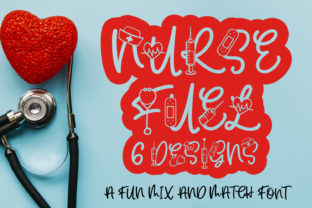
Typography isn’t just about legibility—it’s about tone, context, and cultural resonance. In healthcare-adjacent design—think clinic newsletters, wellness blogs, nursing school presentations, or pediatric clinic signage—the right font can soften clinical sterility while reinforcing empathy and approachability. Enter Nurse Fuel: a playful display font that stands apart not only for its whimsical aesthetic but for its intentional integration of hospital-themed visual motifs. Unlike generic “fun” fonts that rely on exaggerated curves or cartoonish distortions, Nurse Fuel embeds meaning into its glyphs—stethoscopes in ampersands, syringes as bullet points, EKG waveforms tracing letter terminals, and even tiny bandages wrapping around descenders. It’s typography with diagnostic precision and a smile.
More Than Just a Font—A Thematic Toolkit
At its core, Nurse Fuel is a thematic type system, not merely a set of letters. Each character carries subtle narrative weight. The uppercase “H” features a stylized hospital building silhouette embedded in its crossbar; the lowercase “t” ends with a miniature IV drip icon; the ampersand (&) doubles as a looping stethoscope. These aren’t decorative afterthoughts—they’re carefully calibrated to function both typographically and semiotically. When used thoughtfully, they reinforce messaging without requiring additional illustrations or icons.
This layered functionality makes Nurse Fuel especially valuable in contexts where visual economy matters: social media banners for nurse-led wellness accounts, infographics for public health campaigns, or branded merchandise for medical student groups. Because the thematic elements live *within* the type itself, designers avoid stacking redundant visuals—no need for a separate stethoscope icon next to “Nursing Resources” when the word “Resources” already contains a subtle pulse-line flourish in its “R”.
Who Benefits—and How They Use It
The utility of Nurse Fuel spans diverse roles—not just graphic designers, but educators crafting engaging anatomy flashcards, clinic administrators designing patient welcome kits, indie developers building telehealth onboarding flows, and even researchers preparing conference posters for nursing informatics symposia. Its strength lies in bridging professionalism with warmth—a balance many healthcare communicators struggle to strike.
- Educators use Nurse Fuel for slide headers in simulation debriefs or laminated skill-checklists. A header like “Airway Assessment Steps” gains immediate contextual grounding—not through clip art, but through the gentle EKG motif in the “A” and the breathing-tube curve in the “S”.
- Clinic marketers apply it selectively in patient-facing materials: appointment reminder postcards, seasonal flu campaign posters, or mental health awareness month banners. Because it’s a display font—not intended for body text—it works best at scale, where its personality shines without compromising readability.
- Content creators (especially those in nursing TikTok, Instagram, or YouTube) integrate Nurse Fuel into thumbnails and lower-thirds. Its recognizability builds visual consistency across platforms—viewers begin associating that distinctive “medical playfulness” with a specific creator’s voice and values.
- Hobbyists and small business owners—think makers selling embroidered scrubs, enamel pins shaped like pill bottles, or printable nursing study guides—leverage Nurse Fuel to signal niche alignment. Using it on a product label or digital download cover instantly communicates “made by and for nurses,” fostering trust before a single word is read.
Practical Implementation: Strengths and Smart Boundaries
Nurse Fuel excels in high-impact, low-density applications. Its charm emerges most clearly when given breathing room: headlines, logos, section dividers, certificates, and interactive UI elements like call-to-action buttons (“Book Your Shift”, “Take the Quiz”, “Download Care Plan”). What it does not do well—and was never designed to—is serve as body copy. Its expressive forms, variable stroke weights, and embedded icons reduce scannability in long paragraphs. Attempting to set an entire patient education handout in Nurse Fuel would undermine clarity and accessibility—violating core principles of health literacy.
That said, pairing Nurse Fuel with a clean, highly legible sans-serif (like Inter, Open Sans, or even Roboto) creates a powerful typographic hierarchy. For example:
- A blog post titled “5 Evidence-Based Strategies for Night Shift Resilience” uses Nurse Fuel for the headline—its “5” includes a tiny thermometer glyph, and the “R” in “Resilience” bears a subtle heartbeat dot.
- The byline and body text switch seamlessly to a neutral, accessible font.
- Key takeaways appear as bulleted lists—but instead of standard circles or dashes, each bullet is a custom Nurse Fuel glyph: a tiny pill capsule, a hydration droplet, or a resting heart icon.
This hybrid approach honors both function and feeling: Nurse Fuel provides thematic anchoring and memorability; the supporting typeface ensures comprehension and inclusivity—including for readers with dyslexia, low vision, or cognitive fatigue common among overworked clinicians.
Accessibility Considerations You Can’t Skip
While Nurse Fuel invites joy, responsible use demands attention to accessibility standards. Its decorative elements—though delightful—can interfere with screen reader interpretation if misapplied. For instance, using the syringe-shaped “i” dot in a link like nursefuel.com may cause assistive technology to vocalize “nurse fuel dot com” as “nurse fuel syringe com,” creating confusion. Best practice: reserve Nurse Fuel for purely visual, non-interactive elements (headers, logos, decorative dividers), and always use semantic HTML for navigation and content.
Color contrast is another critical factor. Some Nurse Fuel glyphs include fine internal details (e.g., the dotted line inside a “P” representing a blood pressure cuff). At small sizes or low contrast (e.g., light gray on white), these vanish—erasing part of the font’s intent and potentially misleading users expecting iconographic cues. WCAG AA compliance requires a minimum 4.5:1 contrast ratio for text under 18pt (or 14pt bold). Test combinations rigorously—not just against white, but against common clinic wall colors (soft blues, sage greens, warm beiges).
Designing With Intention, Not Just Novelty
What separates effective use of Nurse Fuel from superficial trend-chasing is intentional layering. It’s tempting to default to its most obvious motifs—stethoscopes and red crosses—but its deeper value lies in subtler applications. Consider how a pediatric occupational therapist might use the “O” in “Occupational”—which contains a looping therapy swing—to reinforce therapeutic movement in a handout for parents. Or how a hospice educator could select the “C” in “Compassion,” whose counter shape echoes a folded hands icon, for a workshop title slide.
This level of nuance requires time spent exploring the full glyph set—not just the alphabet, but the extended Latin characters, numerals, punctuation, and alternates. Nurse Fuel includes ligatures (like “st” and “ct”) that form cohesive medical symbols: “st” becomes a suture stitch; “ct” transforms into a CT scan cross-section. These aren’t gimmicks; they’re tools for visual storytelling that reward close reading and deepen engagement.
Beyond Aesthetics: Cultural Resonance in Healthcare Design
In an era where burnout, moral injury, and workforce attrition dominate nursing discourse, fonts like Nurse Fuel reflect a quiet but meaningful shift: toward human-centered design that acknowledges the emotional labor of care work. It doesn’t trivialize medicine—it celebrates the people within it. When a new grad chooses Nurse Fuel for her graduation announcement, she’s not just picking a fun font; she’s asserting identity, pride, and belonging. When a hospital’s wellness committee uses it on a “Staff Appreciation Week” banner, it signals psychological safety and recognition—not just policy compliance.
That resonance extends internationally. While Nurse Fuel’s base encoding supports Western European languages, its visual language translates across borders: a stethoscope is universally legible; a heartbeat waveform needs no translation. Designers in Canada, Australia, Germany, and Singapore report successful adoption—not as novelty, but as shorthand for “this space understands us.” That universality underscores its value in global health communication, where linguistic diversity often limits text-based messaging, but iconographic typography bridges gaps.
Final Thought: Typography as Care Infrastructure
We rarely think of fonts as infrastructure—but in healthcare communication, they are. Just as reliable Wi-Fi enables telehealth or standardized EMR templates reduce cognitive load, thoughtful typography reduces friction in understanding, builds trust through consistency, and affirms identity through representation. Nurse Fuel doesn’t replace clinical rigor or evidence-based writing. Instead, it complements them—adding warmth without sacrificing authority, playfulness without undermining professionalism. Used with purpose, restraint, and respect for its limits, it becomes more than a design choice. It becomes a small, consistent act of recognition: for the nurse checking vitals at 3 a.m., the educator explaining sepsis protocols, the student memorizing drug half-lives, and everyone who shows up—day after day—with both expertise and heart.