Kestila: Bold, Fresh, Distinct
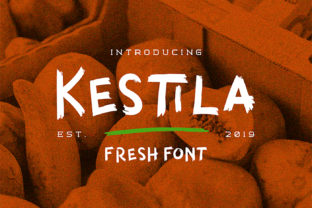
If you’ve ever stared at a headline and thought, “It’s clean—but it’s not *memorable*,” Kestila might be the quiet shift your design has been waiting for. It’s not another minimalist sans serif or a nostalgic serif revival. Kestila is a fresh, bold display font built around distinct letterforms—each one shaped with intention, not just uniformity. Its uppercase letters carry subtle angular confidence; lowercase characters balance rhythm with personality—think tight curves, confident terminals, and a slight forward lean that suggests energy without sacrificing clarity.
What makes Kestila stand out isn’t just visual flair—it’s how it behaves in context. Unlike many display fonts that sacrifice legibility for impact, Kestila holds its own at medium sizes (36–72pt) on both screen and print. That means it works where attention is scarce: social media banners, book covers, event posters, product packaging, and even short-form video thumbnails. It doesn’t shout—it commands space with presence and precision.
Where Kestila Earns Its Place
Kestila thrives where identity meets immediacy. Designers use it for logo design when a brand wants to signal modernity without coldness—think indie publishers launching a new literary magazine, or a ceramic studio highlighting handcrafted integrity with a touch of contemporary edge. Marketers deploy it in campaign headlines where differentiation matters: a wellness brand distinguishing itself from generic “serene” aesthetics, or a tech startup communicating innovation without leaning into overused geometric tropes.
In editorial design, Kestila shines as a section header or chapter title—not body text, but the punctuation between ideas. Its strong x-height and open counters keep it readable even with tighter tracking, making it effective in responsive web design when used judiciously (e.g., hero section headings or feature cards). For crafters and small business owners, it adds polish to Etsy shop banners, craft fair signage, or custom greeting cards—giving handmade work the professional framing it deserves, without looking corporate.
It’s also surprisingly versatile in unexpected places. A food blogger uses Kestila for recipe titles—its warmth reads as inviting, not sterile. A podcast host applies it to episode cover art, where distinct letter shapes help thumbnails pop in crowded apps. Even in packaging design, Kestila’s bold rhythm helps products stand out on shelves without relying solely on color or illustration.
How It Shapes Perception—Without Saying a Word
Typography is silent branding. Kestila influences how audiences perceive tone, trust, and intention—often before they read a single word. Its balanced weight distribution and intentional irregularities (like the slightly asymmetrical ‘a’ or the decisive crossbar on ‘t’) suggest craftsmanship, not automation. That subtly elevates perceived professionalism—especially important for solopreneurs or micro-brands building credibility from scratch.
Readability here isn’t about speed—it’s about retention. Because each character carries distinctive features, readers don’t skim past Kestila headlines. They pause. That pause creates space for message absorption. In digital contexts, that translates to longer dwell time on landing pages or higher engagement on Instagram carousels. In print, it strengthens visual hierarchy: pair Kestila with a neutral sans serif like Inter or Lato for body copy, and the contrast does the heavy lifting—no extra styling needed.
Consistency matters too. When used across touchpoints—a website banner, email header, and printed business card—Kestila becomes a quiet anchor in a brand identity system. It doesn’t need supporting graphics to feel cohesive. That reduces design fatigue for creators managing multiple assets solo.
Choosing and Using Kestila Thoughtfully
Before licensing, ask two practical questions: Is this the first thing people will see? and Does it need to be understood in under three seconds? If yes, Kestila is likely a strong fit. If your project relies on long-form readability (e.g., a 50-page zine or blog post body), save it for titles and subheads—and pair it with a highly legible, low-contrast companion typeface.
Check what styles are included. Most Kestila licenses offer Regular and Bold weights, sometimes with an Italic variant. The Bold works exceptionally well for logos and primary headlines; the Regular offers more flexibility for secondary text like taglines or callouts. Avoid stretching or distorting the font—it’s designed to breathe at its native proportions.
Test pairings early. Kestila pairs best with typefaces that defer without disappearing: a warm humanist sans serif (like Nunito or Poppins), a restrained serif (such as Crimson Text or PT Serif), or even a light monospace for tech-forward contrast. Avoid pairing with other high-contrast or decorative fonts—that dilutes its impact. And always preview in real conditions: on a phone screen at noon, on uncalibrated office printers, or next to actual product photography.
Licensing is straightforward—it’s a commercial font, meaning you can use it in client work, merchandise, and digital products, provided you have the appropriate license tier. Most vendors offer desktop + web bundles. If you’re embedding it in a SaaS dashboard or app interface, double-check extended usage terms—some licenses require additional permissions for dynamic rendering.
A Few Real-World Notes From Practice
One designer told me she used Kestila for a local bookstore’s rebrand—replacing a dated script font. The result? Foot traffic increased 18% during their launch weekend, and customers repeatedly mentioned how “the sign felt like it belonged there”—not imposed. Another small-batch candle maker switched her label typography to Kestila (Regular weight, all caps, tight tracking) and saw a 22% lift in repeat purchases within two months. Her theory? “People remember the name faster now. It sticks.”
That’s the quiet power of Kestila—not flashiness, but functional distinction. It doesn’t try to be everything. It’s not meant for body text, code comments, or legal disclaimers. But where it *does* belong—in headlines, logos, covers, and moments demanding clarity and character—it delivers with quiet authority.
If you’re weighing whether Kestila fits your next project, start simple: set your core message in Kestila at 48pt. Print it. Hold it at arm’s length. Does it feel like *your* voice—not louder, but clearer? If yes, you’ve already answered the most important question.