Benaco
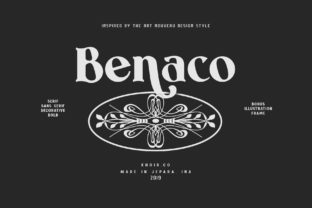
Benaco is a serif display font inspired by the flowing lines, organic motifs, and structural elegance of Art Nouveau. Designed for visual impact rather than extended reading, it features high contrast between thick and thin strokes, subtle curvature in letterforms, and carefully balanced proportions that evoke early 20th-century typography—without replicating historical specimens outright. It is not a revival or digitized scan, but a contemporary interpretation grounded in that aesthetic tradition.
Designers exploring typefaces for branding, packaging, editorial features, or digital campaigns may consider Benaco when seeking a distinctive yet legible serif with stylistic depth. Its appeal lies less in versatility across all text sizes and more in its ability to anchor a composition with intentional character—particularly where tone, heritage, or craftsmanship are part of the message.
When Benaco Aligns With Design Goals
Benaco performs best in controlled typographic environments. It excels in headlines, logos, posters, book covers, and short-form web banners where its expressive qualities can be appreciated at larger sizes—typically 36pt and above in print, or 48px and up on screen. Its design supports visual hierarchy: pairing well with neutral sans-serif companions (e.g., Inter, Lato, or Montserrat) for body copy or supporting text creates clear contrast without competing tonally.
Projects rooted in artisanal, botanical, luxury, or cultural themes often benefit from Benaco’s aesthetic cues. A craft brewery launching a limited-edition label, a boutique hotel emphasizing historic charm, or an independent publisher releasing a monograph on decorative arts—all represent contexts where Benaco reinforces narrative intent without requiring explanation.
The font includes standard Latin characters, basic punctuation, and OpenType features such as ligatures and alternate glyphs. These support typographic refinement but do not extend to extensive language coverage (e.g., no Cyrillic, Greek, or extended diacritics), nor does it include variable axes. Users should verify character set compatibility with their target audience’s linguistic needs before committing.
Limitations and Practical Considerations
Benaco is not intended for body text. Its high stroke contrast and relatively tight spacing reduce readability below ~24pt, especially in low-resolution settings or on smaller mobile screens. Long paragraphs set in Benaco will likely hinder comprehension and increase cognitive load—a tradeoff inherent to display-oriented serifs.
Its Art Nouveau lineage also introduces subtle constraints. Letters like a, g, and e feature closed, rounded counters and delicate terminals that may blur or pixelate if rendered poorly. Previewing output across devices—and testing with real content—is essential before final implementation.
Licensing is another factor. Benaco is typically offered under commercial desktop and web font licenses, with usage tiers based on pageviews or installations. Unlike open-source alternatives, it requires purchase or subscription. Budget-conscious teams evaluating multiple options should compare licensing models alongside technical fit.
Comparing Alternatives
Designers weighing Benaco against other display serifs should assess functional alignment over stylistic preference alone. For example:
- Playfair Display offers broader language support, tighter optical scaling, and wider availability via Google Fonts—making it a pragmatic choice for multilingual websites or rapid prototyping.
- Cormorant Garamond shares some historical reference points but leans toward Renaissance structure rather than Art Nouveau fluidity; it also scales more gracefully into mid-size headings (18–32px).
- IM Fell DW Pica provides authentic historical texture at no cost, though its irregularities demand more manual kerning and may feel less polished in modern UI contexts.
Each alternative reflects different priorities: accessibility, cost, scalability, or authenticity. Benaco distinguishes itself through deliberate stylistic cohesion—not just “vintage-looking,” but consistently referencing a specific design era’s formal logic. That consistency becomes an asset when brand voice hinges on curated atmosphere.
Evaluating Fit for Your Project
To determine whether Benaco suits your needs, ask three questions:
- What role does typography play in conveying meaning? If the font must reinforce a theme—such as handcrafted quality, botanical inspiration, or European heritage—Benaco’s stylistic clarity adds value. If neutrality or universal legibility is primary, a more restrained option may serve better.
- Where and how will it appear? Review actual layouts: mock up headlines alongside interface elements, test rendering on common devices, and confirm fallback behavior in CSS stacks. Benaco works reliably in static graphics and well-optimized web environments—but less predictably in dynamic templates with automated resizing.
- What resources support implementation? Consider time for fine-tuning (kerning pairs, line-height adjustments), budget for licensing, and team familiarity with display font best practices. A well-intentioned choice can falter without attention to these details.
No single font solves every challenge. Benaco fills a specific niche: expressive, historically informed display typography for projects where visual resonance matters as much as function. It rewards thoughtful application—not broad deployment.
For designers already narrowing options based on tone and context, Benaco warrants close review alongside specimen tests and real-content trials. Those beginning their search may first clarify goals—audience, medium, scale, and message—before turning to stylistic attributes. Doing so helps avoid mistaking novelty for suitability, and ensures the final choice supports, rather than competes with, the work it frames.